The IRS business standard mileage rate rose from 70 cents per mile in 2025 to 72.5 cents for the first half of 2026, then increased to 76 cents per mile for business travel from July 1 through December 31, 2026. When comparing mileage reimbursement companies, buyers should distinguish full program administrators from apps that primarily document trips.
The six options below represent different service models rather than a universal ranking.
Quick Answer: Which Mileage Reimbursement Company Should You Choose?
The right mileage reimbursement company depends on what your organization needs managed.
Employers that need program design, reimbursement-rate development, FAVR administration, driver support, and ongoing oversight may benefit from a full-service provider such as mBurse, Motus, or Cardata.
Organizations primarily looking for mileage tracking, expense submission, and approval workflows may also consider software-focused options such as CompanyMileage, Driversnote, or Zoho Expense.
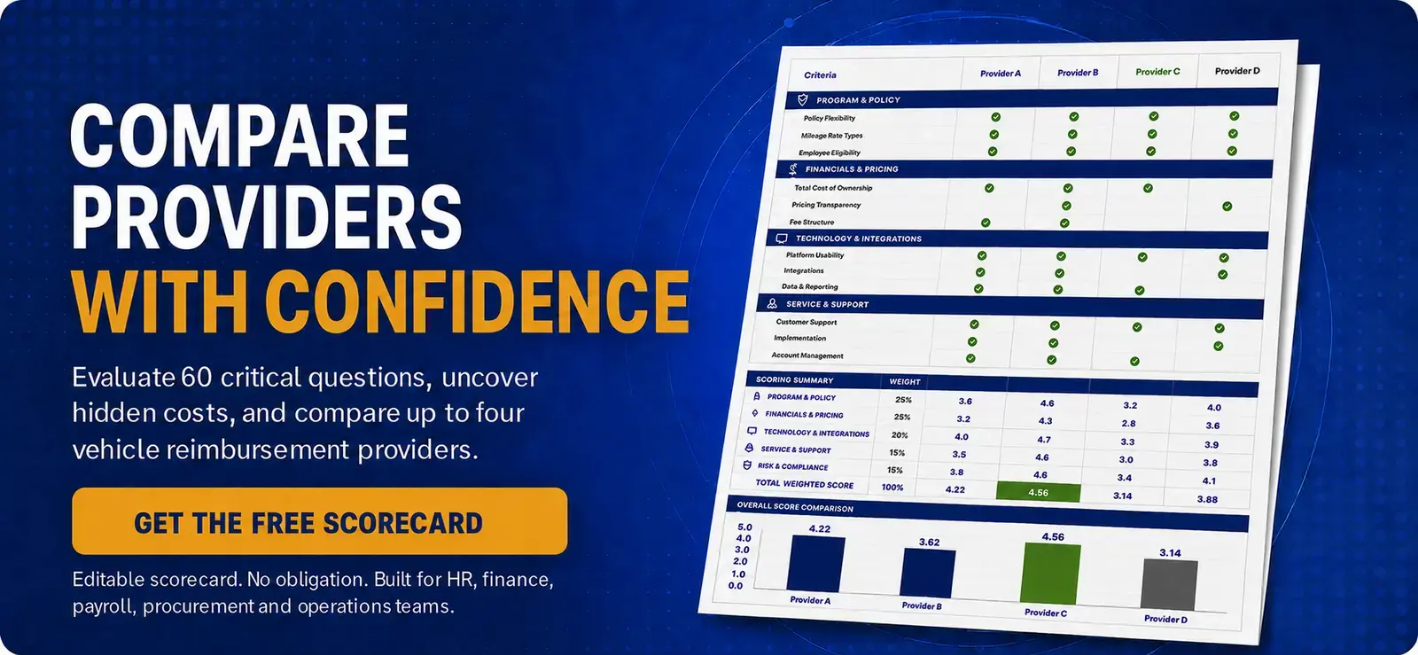
Compare providers based on reimbursement methods, administrative support, mileage tracking, integrations, reporting, geographic coverage, and the amount of work your internal team will need to manage.
How We Evaluated Vehicle Reimbursement Providers
Car reimbursement companies help employers design, administer, track, approve, and report payments for employees who use a personal vehicle for business. We evaluated reimbursement methods, tax support, mileage capture, approval workflows, expense-system integration, implementation support, driver support, and geographic coverage.
Reporting quality also matters because vehicle wear, reimbursement expense, and employee activity require different forms of analysis. Buyers should seek robust reporting and analytics dashboards to monitor productivity and support business growth, but each report must use reliable and appropriately governed data.
This guide compares documented capabilities, not overall performance. Confirm current features, pricing, service scope, integrations, and availability directly with each provider.
Reimbursement Approaches Buyers Should Understand
Cents per mile: The employer pays for documented business miles using its selected rate or the applicable standard mileage rate. This approach is easy to explain, but one rate may not reflect geographic differences in fuel costs or vehicle ownership costs.
FAVR: A fixed and variable rate program separates fixed costs, such as insurance and depreciation, from variable costs, such as fuel and maintenance. In a FAVR reimbursement program, local cost data can support location-sensitive fixed and variable payments, although administration is more demanding.
Car allowance: A recurring allowance provides a predictable payment but does not itself document business use. Mileage tracking creates a mileage log that may support cents-per-mile, FAVR, or allowance-plus-mileage arrangements.
Full-Service Providers Versus Mileage-Tracking Apps
Full-service providers may supply program design, rate development, tax documentation, implementation guidance, managed administration, reporting, and employee support. That broader service model can reduce internal work where policy exceptions or reimbursement calculations require specialist oversight.
Mileage-tracking apps concentrate on trip capture, mileage logs, manager approvals, and exports. They can suit straightforward policies, but software alone may not replace reimbursement consulting, rate governance, or ongoing program administration.
1. mBurse
mBurse is a vehicle reimbursement provider to consider when employers need program design and managed administration alongside reimbursement software.
Overview
mBurse serves organizations whose mobile employees use personal vehicles for work. Its stated scope includes cents-per-mile reimbursement, car allowances, FAVR, mileage tracking, and managed administration.
Key and Standout Features
The provider combines data-backed consulting with GPS tracking, approval dashboards, reporting and analytics, and ongoing administration. Its mileage tracker app offers automatic GPS tracking, while stated connections with Concur, Salesforce, and Workday should be reviewed for technical requirements and available configurations.
Pricing and Ideal Fit
Pricing is quote-based and should reflect program type, driver count, locations, and service requirements. mBurse may fit HR, finance, operations, and fleet leaders needing tailored design and administrative oversight.
Verdict
mBurse helps businesses manage personal vehicle reimbursement with confidence by combining tax-compliant program design with software and professional services. Although its marketing references fully managed program administration ensuring 100% IRS compliance and reduced administrative burden, employers remain responsible for confirming that program design, documentation, and operation satisfy IRS requirements.
The IRS Compliance Assurance Process is a separate IRS LB&I program for large corporate taxpayers that uses real-time issue resolution before filing, rather than a general vendor compliance designation.
2. Motus
Motus is a vehicle and mobile-workforce reimbursement provider worth investigating where structured programs and enterprise operating requirements are priorities.
Overview
The company is associated with vehicle reimbursement and mileage solutions for distributed workforces. Buyers should verify supported reimbursement models, countries, currencies, and administrative workflows against current first-party documentation.
Key and Standout Features
Evaluate trip capture, policy controls, reporting, payroll or expense connectivity, rate updates, and policy exceptions. Buyers should also ask who handles onboarding, exception resolution, annual changes, and employee questions.
Pricing and Ideal Fit
Request a proposal separating software, implementation, administration, and support charges. Motus may suit larger organizations that need reimbursement managed at the program level.
Verdict
Include Motus when scale and structured reimbursement are central requirements. Compare its current service model with providers offering hands-on consulting and fully managed administration.
3. Cardata
Cardata is another provider to evaluate when an employer needs more than basic mileage capture and wants to compare several reimbursement methods.
Overview
Cardata publishes educational information about vehicle reimbursement structures and program selection. Its current service catalog, supported countries, and available configurations should be confirmed through first-party sources.
Key and Standout Features
Examine support for FAVR, allowances, cents-per-mile payments, policy administration, mileage capture, and reporting. Request documentation covering implementation milestones, rate methodology, audit records, and employee-facing support.
Pricing and Ideal Fit
Treat pricing as quote-based unless Cardata publishes current first-party rates. It may fit employers seeking reimbursement-model flexibility and formal program controls.
Verdict
Shortlist Cardata where program administration and method selection carry substantial weight. A live demonstration should confirm reporting depth, integrations, geographic coverage, and division of responsibilities.
4. CompanyMileage
CompanyMileage is a software option centered on mileage, expense submission, and reimbursement-related workflows rather than broad program consulting.
Overview
The platform describes tools for mileage tracking, expense logging, supervisory review, approvals, and payment processes. Buyers should separate these operational capabilities from full-service reimbursement design.
Key and Standout Features
Review real-time expense entry, mileage logs, configurable workflows, supervisor approvals, exports, and payment handling. Confirm support for custom rates, allowances, FAVR, and each required payroll integration.
Pricing and Ideal Fit
Ask whether charges vary by employee, administrator, transaction volume, or service tier. CompanyMileage may suit organizations prioritizing employee expense submissions and manager review.
Verdict
Consider CompanyMileage for mileage and expense workflow automation. Employers needing policy design, compliance administration, or dedicated driver support should determine whether supplementary expertise is necessary.
5. Driversnote
Driversnote is an app-led mileage-tracking option for employers that primarily need business-trip documentation and team oversight.
Overview
The platform is associated with automatic mileage recording and team mileage reporting. Buyers should confirm current employer controls, reimbursement calculations, regional availability, and privacy settings.
Key and Standout Features
Evaluate automatic trip detection, trip classification, mileage reports, approval processes, and administrator visibility. Data retention, personal-trip handling, exports, and device requirements can materially affect employee adoption.
Pricing and Ideal Fit
Verify current team plans and compare subscription expense with the internal time required for administration. Driversnote may fit teams that need practical mileage capture without extensive reimbursement consulting.
Verdict
Include Driversnote when reliable trip records are the immediate priority. Conduct a separate review if the employer also needs FAVR expertise, allowance governance, or outsourced administration.
6. Wheels
Wheels is a fleet and vehicle reimbursement provider to consider when employers need structured reimbursement alongside broader mobility and fleet services.
Overview
Wheels supports reimbursement programs including cents per mile and Fixed and Variable Rate (FAVR), along with mileage tracking, reporting, compliance-related services, and driver support.
Key and Standout Features
Buyers should evaluate FAVR and mileage reimbursement administration, business mileage capture through the Wheels Mobile Assistant, reporting through FleetView, insurance validation, driver support, and available safety and fleet services.
Pricing and Ideal Fit
Confirm current pricing, implementation costs, and service requirements directly with Wheels. It may fit larger organizations looking for reimbursement administration that can integrate with broader fleet and mobility operations.
Verdict
Wheels belongs on the shortlist when an employer wants a full-service vehicle reimbursement provider rather than only a mileage-tracking app. Buyers should compare its reimbursement capabilities, administrative support, and broader fleet services against the specific needs of their workforce.
Side-by-Side Comparison Criteria
The following table identifies questions to verify rather than awarding unsupported scores. “Confirm with provider” means that capabilities may depend on plan, location, configuration, or contract.
Managed administration, consulting, driver support, geographic coverage, and implementation responsibilities should be documented in each proposal. Tax treatment and accountable-plan treatment depend on program structure, substantiation, documentation, and consistent administration, not the vendor’s name alone.
What the Table Should Not Claim
A defensible comparison should not promise savings, tax outcomes, compliance guarantees, customer volumes, or the lowest price without current evidence. A standard mileage rate is a calculation input, a reimbursement policy is an employer rule, and an IRS accountable plan requires a business connection, adequate substantiation, and the return of excess amounts within a reasonable period.
How to Build Your Shortlist
Begin with driver count, annual business mileage, employee locations, vehicle types, travel patterns, and the frequency of personal-vehicle use. These inputs determine whether the company needs a lightweight tracking tool or a structured reimbursement program.
Match the operating model to the payment method: cents per mile for documented mileage, FAVR for separated fixed and variable costs, or an allowance where policy and tax treatment make it appropriate. Expert vehicle reimbursement consulting can help design and roll out fair, competitive programs with data-backed benchmarks, but buyers should test whether that expertise is included in the quoted service.
Request an implementation plan, security documentation, integration scope, sample reports, support terms, and references from comparable programs. Also assign ownership for payroll support, rate maintenance, exceptions, reconciliation, and employee questions.
Questions for Finance, HR, Operations, and Fleet Teams
Finance should examine budget predictability, payroll treatment, expense reconciliation, reporting, and the audit trail from trip record to payment. HR, operations, and fleet teams should assess fairness, driver adoption, privacy, policy clarity, safety expectations, manager workload, and employee communications.
Choose the Provider That Fits Your Program
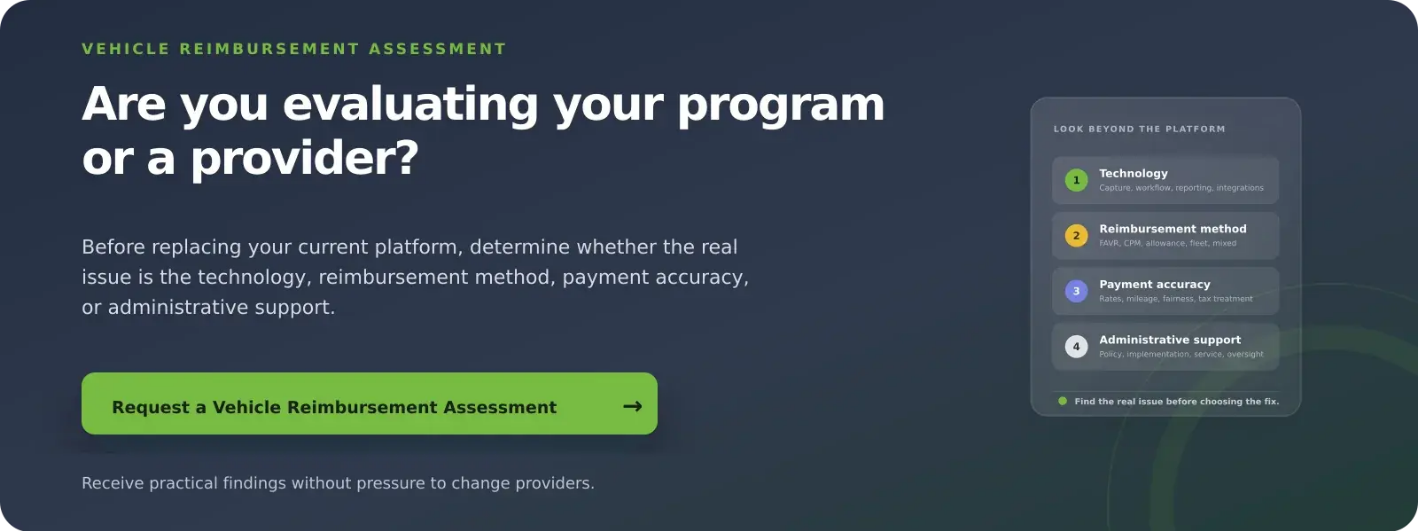
The right provider depends on the reimbursement method, driver population, geographic footprint, internal capacity, and desired level of professional guidance. A structured review should cover current policy, mileage documentation, approvals, payment processing, reporting, integrations, and employee experience before any vendor change.
Frequently Asked Questions About Mileage Reimbursement Companies
How Much Should a Company Reimburse for Mileage?
The appropriate amount depends on company policy, business-use documentation, applicable tax rules, and the chosen method. Employers commonly use a standard mileage rate or a structured alternative such as FAVR.
Do Companies Legally Have to Pay You Mileage?
Department of Labor guidance does not establish a universal federal requirement for employers to reimburse every employee’s personal-vehicle mileage. Under the FLSA, however, unreimbursed business vehicle costs may create a minimum-wage issue if they effectively reduce pay below the required minimum wage for the workweek.
State and local rules can impose additional obligations, so employers should obtain jurisdiction-specific advice.
What Proof Is Needed for Mileage Reimbursement?
A defensible mileage record includes the trip date, business purpose, destination or starting and ending locations, and business miles driven. IRS Publication 463 also supports keeping documentary evidence that verifies the expense and business use.
The policy should also define submission deadlines, required substantiation, and manager approval rules.
Can I Claim Mileage If My Company Pays for Gas?
Eligibility depends on the employer’s policy and reimbursement method. The program should prevent duplicate payment for the same fuel or vehicle cost and document whether fuel, mileage, or actual-expense reimbursement applies.
A credible selection process compares documented capabilities against the employer’s actual administrative burden and driver needs. Reviewing those factors before requesting proposals produces a shorter, more relevant list of mileage reimbursement companies.