

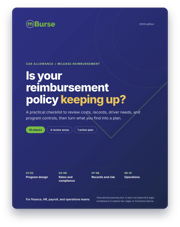
FREE POLICY CHECKLIST
Car Allowance & Mileage Policy Review Checklist
Review ten areas of your policy, document what needs attention, and assign the next steps.
Get the policy checklistStart with your details, then answer a few questions about your program.
Accountable Plan Car Allowance
Keep the allowance your drivers already know. mBurse makes it tax-free up to their documented business miles, without FAVR’s driver minimums, vehicle rules, and insurance audits.
Same monthly paymentA familiar allowance for drivers
Documented business milesMileage substantiation + policy controls
Tax-free + taxable portionsThe monthly split, ready for payroll
Documented business miles determine the substantiated amount. Return excess advances within a reasonable period; excess not returned is treated as taxable wages.
The direct answer
An accountable plan requires a business connection, timely substantiation and return of excess advances within a reasonable period. Excess that is not returned within that period is treated as taxable wages. Taxing retained excess is not a substitute for operating the plan under the accountable-plan rules.
Also called: a tax-free car allowance, non-taxable car allowance or accountable car allowance. A car allowance with no mileage records is a non-accountable plan, and it's fully taxable.
An accountable plan is a framework, not a formula. Cents per mile, FAVR and accountable allowances can all run under it.
Why mBurse for allowances
mBurse can set monthly allowances by location and mileage band to reflect some differences in driving costs. The amount stays fixed within each group; FAVR instead calculates separate fixed and variable payments using each driver’s local vehicle costs.
Allowance amounts that reflect fuel, insurance and ownership costs in the areas your drivers work.
Different amounts for different mileage groups, instead of one flat number for everyone.
Rates checked against your industry and companies your size, so your allowance stays competitive for hiring and retention.
We'll walk through your driver groups on a short call.
Same allowance. Less tax.
A standard car allowance is taxed as wages. An accountable allowance isn't taxed on the part covered by documented business miles. Here's the same $600 paid both ways.
Same $600 allowance, two ways · one driver, one month, 650 documented business miles
| Line item | Taxable allowance | Accountable allowance |
|---|---|---|
| Monthly allowance | $600.00 | $600.00 |
| Tax-free portion | $0.00 | $494.00 |
| Taxable wages | $600.00 | $106.00 |
| Employer FICA | $45.90 | $8.11 |
| Driver take-home | $420.00 | $568.20 |
Driver keeps$148.20 more each month$1,778.40 more a year Employer saves in FICA$37.79 each month$453.48 a year | ||
Tax-free portion = 650 miles × 76¢, capped at the $600 allowance. Assumes a 30% combined driver tax rate and 7.65% employer FICA; actual taxes vary, including wage-base limits. Annual figures repeat this monthly example for 12 months at the selected rate; they are not a reconstruction of calendar-year 2026 taxes. Annual figures shown use rounded monthly amounts. Example assumption: the substantiated reimbursement is treated separately from any retained amount processed as taxable wages. The tables illustrate that payroll treatment; they do not establish that an employer's plan meets all accountable-plan requirements. Sources checked October 25, 2026: IRS Publication 463 (2025), Chapter 6 and IRS Announcement 2026-11. The 76¢ rate applies from July 1, 2026; 72.5¢ applies January 1–June 30.
Tell us about your team first, then choose what you need. We’ll contact you to discuss your program and next steps.
Step 1 of 2 · Your team
Thanks. We’ve received your program request and will contact you to get started. You can also choose a time to talk below.
Book a call →Three core requirements
The IRS looks at how a plan actually operates, not what payroll calls it. All three have to be built into your policy, your drivers' routine and your monthly payment process.
Payments cover ordinary and necessary expenses employees incur, or are reasonably expected to incur, while working for you.
How mBurse handles it: eligibility is set by role and driving expectation, so only business drivers are enrolled.
Employees document the amount, date, place and business purpose of their driving within a reasonable period (60 days after the expense under the fixed-date safe harbor).
How mBurse handles it: trips are captured automatically, and drivers classify and submit them every month.
Any amount above substantiated expenses is returned within a reasonable period (120 days after the expense under the fixed-date safe harbor). Excess not returned is treated as taxable wages.
How mBurse handles it: the excess is calculated for every driver, and payroll gets a ready-to-process file.
Sources checked October 25, 2026: IRS Publication 463 (2025), Chapter 6, and Treasury Regulation §1.62-2. Excess advances must be returned within a reasonable period; unreturned excess is taxable wages.
FREE POLICY CHECKLIST
Review ten areas of your policy, document what needs attention, and assign the next steps.
Get the policy checklist →Month to month
Each month, mBurse compares documented business miles with the allowance to identify the substantiated amount and any excess. Your policy sets return-of-excess requirements and payroll handles taxable amounts. Example assumption: the substantiated reimbursement is treated separately from any retained amount processed as taxable wages. The tables illustrate that payroll treatment; they do not establish that an employer's plan meets all accountable-plan requirements.
One driver, three months, $600 allowance · tax-free portion = documented business miles × 76¢, up to the allowance
| Line item | JulyBusy month | SeptemberTypical month | DecemberSlow month |
|---|---|---|---|
| Business miles | 900 | 650 | 300 |
| Tax-free | $600.00 | $494.00 | $228.00 |
| Taxable wages | $0.00 | $106.00 | $372.00 |
| Driver take-home | $600.00 | $568.20 | $488.40 |
| On a taxable allowance, the same driver takes home $420.00 every month, regardless of miles. | |||
Assumes a 30% combined driver tax rate and the 76¢ business rate applicable to the illustrated July, September and December 2026 trips. Sources checked October 25, 2026: IRS Announcement 2026-11 and Publication 463 (2025). The allowance is the ceiling: miles beyond it don't add pay unless your policy includes a top-up, which some states may effectively require. Illustrative only.
Compare the approaches
An accountable allowance can reflect some local cost differences through location and mileage bands. The monthly amount stays fixed within each group, while FAVR calculates separate fixed and variable amounts using each driver’s local vehicle costs. Many employers use more than one method.
| Taxable allowance | Accountable allowance | Cents per mile | FAVR | |
|---|---|---|---|---|
| How it pays | Fixed monthly amount | Monthly amount, split by documented miles | Business miles × rate | Fixed + variable, by location |
| Reflects local costs | Usually one flat amount | Partly: by location and mileage band | No: one rate everywhere | Yes: calculated for each driver |
| Rate benchmarking | Not included | Against your industry and size | IRS rate or your own | Set by the FAVR calculation |
| Federal tax | Fully taxable wages | Qualifying substantiated portion excluded from wages; excess must be returned, or unreturned excess treated as wages | Tax-free up to the IRS rate | Tax-free when FAVR rules are met |
| Minimum drivers | None | None | None | At least 5 at all times |
| Mileage threshold | None | None | None | 5,000+ business mi/yr expected |
| Vehicle rules | None | None | None | Cost cap ($61,700 in 2026) and age rules |
| Insurance checks | No | Not required | Not required | Proof meeting program minimums |
| Mileage records | Not required | Required monthly | Required | Required |
| Best fit | Simplicity over tax cost | Regular drivers who want a steady payment | Occasional, lower-mileage drivers | High-mileage drivers who need a per-driver calculation |
Federal treatment assumes plan requirements are met; state rules can differ. Some drivers a better fit for FAVR? See how mBurse runs FAVR →
Match the method to the driver
Not sure? Compare my options → We'll recommend a method for each driver group.
Tax treatment and reimbursement
Yes. Federal rules decide what's taxable; some states separately require employers to cover employees' necessary business expenses, including driving. An accountable allowance can meet both, as long as the amount is adequate.
Labor Code §2802 requires employers to fully reimburse necessary business expenses. The California Supreme Court has held that a lump-sum allowance is allowed if it actually covers those costs, and the employer must make up any shortfall.
The Illinois Wage Payment and Collection Act requires reimbursement of necessary expenditures employees incur within the scope of their job, when submitted according to the employer's written policy.
Other states, including Massachusetts, Montana, New Hampshire, North Dakota and South Dakota, have broad necessary-expense laws. See the state-by-state guide → General information, not legal advice.
Put the program in place
Most companies switch in 30 days or less, measured from signed agreement to first payroll run. mBurse runs the program and your team approves it, and drivers keep getting paid every month throughout.
Review your roster, current allowance, typical mileage and where your drivers work, and benchmark the allowance against your industry.
Accountable allowance for most drivers; FAVR or cents per mile where they fit better.
An accountable-plan policy covering eligibility, substantiation deadlines and excess handling.
Drivers install the app, see exactly what's tracked and learn to classify trips in minutes.
Miles reviewed, exceptions flagged by mWatch, and a ready-to-process payroll file with every record kept.
Existing payroll codes and file formats are mapped, so payroll sees no change.
Keep FAVR groups running while other drivers move to an accountable allowance.
Driver, mileage and payment data migrate from your current provider or spreadsheet.
Compare your taxable allowance with an accountable plan using your numbers, then get a closer look across your driver groups, locations and mileage.
Accountable plan FAQ
Clear answers about tax treatment, mileage tracking and choosing the right method.
Review IRS Publication 463 →An accountable plan is an employer reimbursement or allowance arrangement that meets three IRS requirements: a business connection, adequate substantiation, and return of excess amounts. Payments made under one are generally excluded from wages. It is a framework that cents-per-mile, FAVR, and accountable allowances can all use.
“Tax-free car allowance” is another name for an accountable car allowance: a regular monthly payment that is excluded from wages up to the employee’s documented business miles at the IRS rate. Any amount above that is treated as taxable wages.
An accountable plan requires a business connection, substantiated business use, and return of any excess, so qualifying payments are excluded from wages. A non-accountable plan, such as a standard car allowance with no mileage records, is treated as taxable wages for both employer and employee.
Yes. mBurse can help set fixed monthly amounts for groups based on location and mileage bands. Those bands can reflect some local cost differences, which is why comparison tables describe this as “partly.” The allowance is not recalculated for each driver’s local fixed and variable costs as FAVR is. The accountable-plan substantiation and return-of-excess requirements still apply.
mBurse benchmarks your allowance against your industry and companies your size, then recommends amounts by location and mileage band. Contact us and we'll walk through your driver groups on a short call.
Within a reasonable period. Under the IRS fixed-date safe harbor, expenses substantiated within 60 days after they were paid or incurred are treated as timely, and excess amounts returned within 120 days after the expense are too. mBurse has drivers classify and submit trips every month.
Partly or fully, depending on mileage. The portion up to substantiated business miles multiplied by the IRS standard mileage rate is generally tax-free. Anything above that amount that is not returned is treated as taxable wages.
A flat monthly allowance can qualify when the arrangement meets business-connection, substantiation and return-of-excess requirements. Excess not returned within a reasonable period is taxable wages; treating it as wages does not, by itself, establish that the plan is accountable.
An accountable allowance pays a fixed monthly amount that can differ by location and mileage band. FAVR calculates separate fixed and variable payments using each driver’s local vehicle costs and has additional IRS requirements. Both require appropriate business-mileage records and administration.
Yes. Many employers match the method to the driver group: FAVR for high-mileage field reps, an accountable allowance for regular drivers, and cents-per-mile for occasional drivers. mBurse administers all three on one platform.
An accountable plan requires a business connection, timely substantiation and return of excess advances within a reasonable period. Excess that is not returned within that period is treated as taxable wages. Taxing retained excess is not a substitute for operating the plan under the accountable-plan rules. mBurse identifies the substantiated amount and excess for payroll review. Your policy and payroll process determine the required handling.
Yes. Employees must record the date, destination, business purpose, and miles for each business trip. Commuting between home and a regular workplace does not count as business mileage. The mLog app captures trips automatically and lets drivers classify and correct them before submitting.
Cents-per-mile pays only for the miles driven, so the amount changes every month. An accountable allowance pays a predictable monthly amount and uses mileage to determine how much of it is tax-free. Employees get a steady payment; employers get the same tax treatment for substantiated miles.
It can. California Labor Code section 2802 requires employers to fully reimburse necessary business expenses, and the California Supreme Court has held that a lump-sum allowance is allowed if it actually covers those costs. The employer must make up any shortfall, so the allowance amount should be reviewed against real driving costs.
Yes. A car allowance paid without mileage substantiation or a requirement to return excess amounts is a nonaccountable payment. It is treated as wages, subject to income tax withholding and Social Security and Medicare taxes for both the employee and employer.
Related client experience: Read the oil-and-gas accountable allowance and fuel-policy story. This example combines allowance and fuel-use controls; outcomes depend on the program and are not a forecast for your team.
Keep the benefit. Improve the structure.
Step 1 of 2
Five quick details, then choose a time that works for you.
The calendar shows available times in your time zone.
We’ll send your calendar invitation and meeting details by email. We look forward to talking about your program.