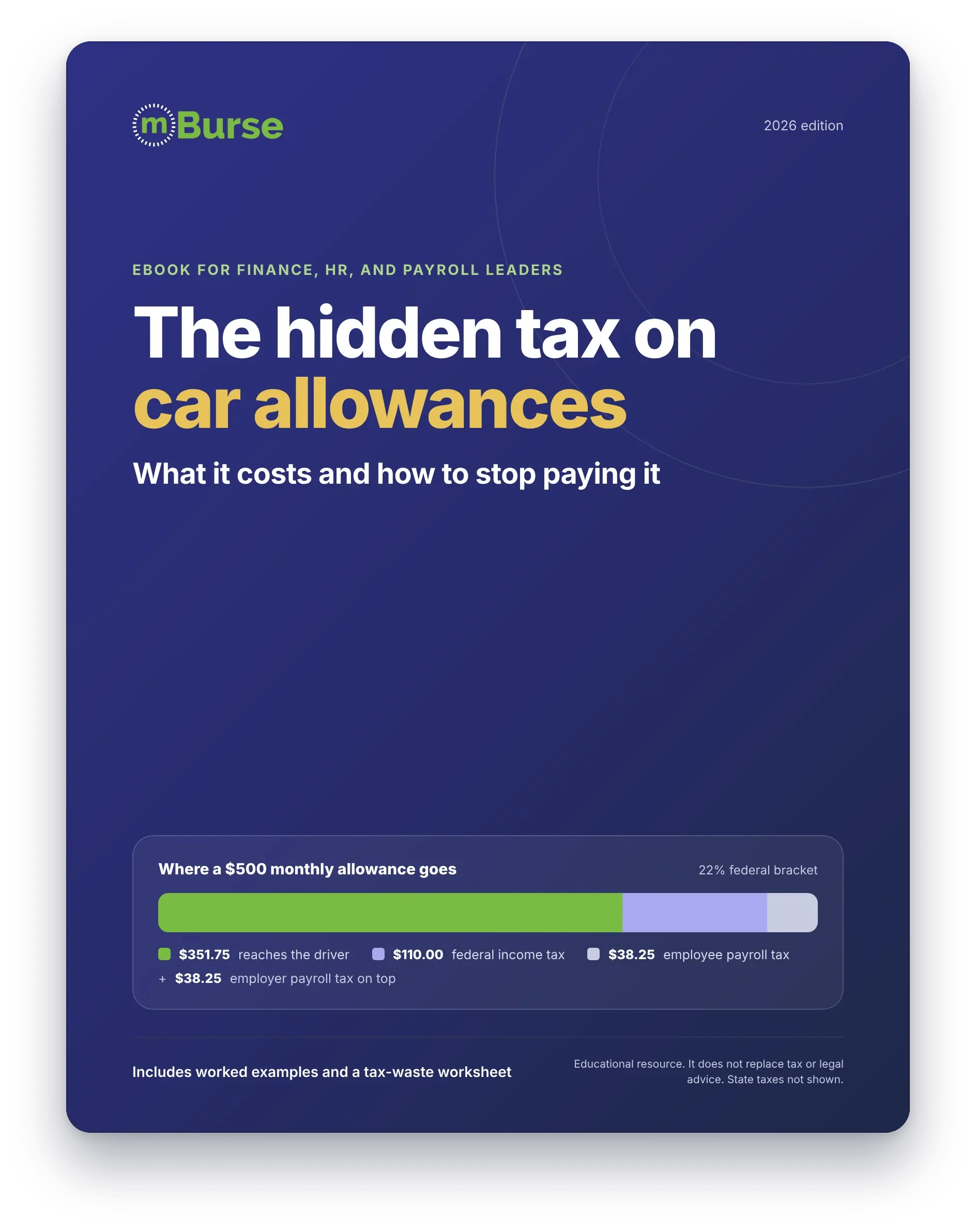
Chapter 1 · Total cost
What does a vehicle reimbursement program really cost?
The payments, plus five costs that rarely show up in the travel and expense budget: payroll taxes on taxable payments, administration, overpayment to some drivers, underpayment that drives turnover, and inflated mileage. mBurse’s 2026 Car Allowance Survey found an average monthly allowance of $739 across 250 companies. When that allowance is taxable, payroll taxes increase the employer’s cost and reduce what reaches the employee.
| Cost | Where it hides | Covered in |
|---|---|---|
| Payroll taxes | Employer FICA on taxable car allowances and fuel cards | Chapter 2 |
| Overpayment | High-mileage drivers paid a flat per-mile rate, or allowances above real costs | Chapter 3 |
| Underpayment | Turnover, recruiting, and lost productivity among under-reimbursed drivers | Chapter 3 |
| Mileage overreporting | Rounded or padded manual logs | Chapter 4 |
| Administration | Manual log review, payroll corrections, and policy exceptions | Chapters 4 and 5 |
| Compliance exposure | Missing substantiation, state reimbursement claims, and audit adjustments | Chapter 8 |
mBurse illustrative analysis. Illustrative tax calculation: 24% federal income tax plus 7.65% employee FICA and 7.65% employer FICA, before state taxes. Actual tax costs depend on the employee’s circumstances and applicable payroll limits.
Running company vehicles instead? The company car to reimbursement guide covers fleet costs and transitions.
Chapter 2 · Tax waste
How much does a taxable car allowance cost compared with an accountable plan?
A $600 monthly car allowance paid as taxable wages loses $235.80 a month to taxes across the employee and employer. In the 24% federal bracket, the employee pays $45.90 in FICA and $144.00 in federal income tax and keeps $410.10. The company pays another $45.90 in employer FICA. That is $2,829.60 per employee per year, before state income tax. A qualifying non-taxable plan can reimburse the full substantiated amount without that tax loss.
The math: $600 × 7.65% = $45.90 for each side; $600 × 24% = $144.00. Employee net: $600 − $45.90 − $144.00 = $410.10. Combined monthly tax: $45.90 + $144.00 + $45.90 = $235.80; × 12 = $2,829.60.
| Drivers | Employer FICA a year | Employee withholding a year | Total tax waste a year |
|---|---|---|---|
| 25 | $13,770 | $56,970 | $70,740 |
| 100 | $55,080 | $227,880 | $282,960 |
| 500 | $275,400 | $1,139,400 | $1,414,800 |
mBurse illustrative analysis. $600 a month per driver; 24% federal income tax plus 7.65% employee FICA; 7.65% employer FICA. Employee withholding is $189.90 a month. State income tax is excluded; Social Security tax applies only up to the annual wage base.
The employer's share is a direct cost. The employee's share is a hidden one: drivers who keep $410.10 of a $600 allowance often ask for more, or quietly cut corners on the vehicle and insurance the job needs.
Run your numbers
Car allowance calculator
See the allowance your drivers need, its tax cost, and the accountable-plan comparison for your team.
How allowances are taxed, and what makes a plan accountable, is covered in the car allowance guide.
Chapter 3 · Rate accuracy
Why do flat rates overpay some drivers and underpay others?
Because vehicle costs are part fixed and part per-mile, and they vary by location. A single per-mile rate underpays low-mileage drivers, whose fixed costs aren't covered, and overpays high-mileage drivers once their fixed costs are paid. A flat allowance ignores mileage and location entirely, so it misses in both directions.
Low mileage
Underpaid
Fixed costs like insurance and depreciation go uncovered. Expect pushback and turnover.
High mileage
Overpaid
Every mile past break-even adds margin for the driver and cost for you.
High-cost areas
Short on fixed costs
Insurance, registration, and fuel vary widely by state and city.
The IRS standard mileage rate (72.5¢ for January–June 2026, 76¢ from July 1) is built on national average costs. It's a useful tax benchmark, not a cost-accurate rate for any one driver.
Finance can see the size of the problem with two numbers per driver group: monthly business miles and the local cost of the vehicle the job requires. Programs that pay a fixed amount for ownership costs plus a per-mile amount for operating costs, set by location, close most of the gap.
Go deeper by method
This guide covers the cost of each approach. These cover how each one works:
A driver with 500 business miles a month receives $380.00 at the current 76¢ rate ($362.50 at 72.5¢ before July 1). At 2,000 business miles, the payment is $1,520 ($1,450 before July 1). These rates are tax benchmarks, not a measure of each driver’s actual costs.
AAA’s 2025 average was $11,577 a year—about $965 a month—at 15,000 miles annually. Depreciation, insurance, and registration remain even when business mileage is low. Full-coverage auto insurance can cost several times more in one state than another. On October 20, 2026, AAA reported regular gasoline at $6.14 in California and $4.28 nationally.
Replacing an employee can cost one-half to two times their annual salary, according to Gallup’s turnover cost estimate.
Chapter 4 · Controls
How can finance control mileage overreporting and expense fraud?
Remove manual entry where you can, then verify what's left. Automated mileage capture eliminates rounding and padding; manager approval with trip detail, policy limits, exception reports, and periodic audit samples catch the rest. Expense reimbursement schemes appeared in 13% of occupational fraud cases studied by the ACFE, with a median loss of $50,000.
| Control | What it prevents |
|---|---|
| Automated mileage capture | Rounded, estimated, or invented trips |
| Approval with trip detail | Personal or commuting miles claimed as business |
| Policy limits and thresholds | Outsized claims slipping through |
| Exception reports | Outliers going unnoticed: unusual totals, duplicates, weekend spikes |
| Quarterly audit sample | Gradual drift in a team's claims |
| Segregation of duties | One person submitting, approving, and paying |
How to capture mileage accurately, and what a log must record, is covered in the mileage tracking guide.
Chapter 5 · Planning
How should finance budget and forecast vehicle reimbursement?
Forecast by driver group, not one line. For each group, multiply drivers by expected business miles and the per-mile rate, add fixed monthly payments, and add employer FICA on anything taxable. Then plan for the variables that move the number: IRS rate changes, fuel prices, headcount, territory changes, and unreported mileage at period end.
Monthly cost per group = drivers × (fixed payment + business miles × per-mile rate)
+ payroll tax = taxable payments × 7.65%
+ administration = internal hours × loaded rate, or vendor fees
Plan for midyear rate changes
The IRS raised the business rate on July 1, 2026, from 72.5¢ to 76¢. Programs tied to the IRS rate saw a 4.8% increase in per-mile cost in the second half of the year. Build rate scenarios into the forecast, and accrue for mileage that's driven but not yet submitted at month end.
- Budget by driver group and cost center
- Model a rate change scenario each half year
- Accrue for unsubmitted mileage at period end
- Reforecast when territories or headcount change
Chapter 6 · Measurement
Which metrics should finance track for a vehicle program?
Track cost per driver and cost per business mile, the share of vehicle payments that are taxable, payroll tax paid on them, how many drivers are over- or under-reimbursed against local costs, substantiation compliance, administrative hours, and turnover among drivers. Review them quarterly and by driver group, not just in total.
| KPI | What it tells you |
|---|---|
| Total cost per driver per month | Payments + payroll tax + admin, comparable across programs |
| Cost per business mile | Whether high-mileage drivers are overpaid |
| Share of payments taxable | How much of the program leaks to payroll tax |
| Payment vs. local cost, by driver | Who is over- or under-reimbursed |
| On-time substantiation rate | Accountable-plan health and audit readiness |
| Admin hours per month | The internal cost of running the program |
| Driver turnover | Whether underpayment is costing you people |
Chapter 7 · Decision
How do you build the business case for changing vehicle programs?
Baseline today's total cost, model the alternative with the same drivers and miles, and compare. Include payments, payroll taxes, administration, implementation and vendor fees, and the cost of over- and underpayment. Then show the payback period, the effect on what employees keep, and the compliance risk reduced.
mBurse illustrative analysis. Illustrative, before administration and vendor fees, and before rate changes by driver group. Employee withholding assumes 24% federal income tax plus 7.65% FICA; state tax is excluded.
- BaselinePull 12 months of payments, payroll tax, admin time, and driver turnover.
- ModelPrice the alternative for each driver group with local costs and real mileage.
- Add the one-time costsImplementation, communication, and any transition support.
- Show the resultAnnual savings, payback period, employee impact, and risk reduced.
Next steps for the decision
The business case answers "should we?" These answer "with whom?" and "how?":
Chapter 8 · Compliance
What should finance check to keep a vehicle program audit-ready?
That every non-taxable payment meets the accountable-plan rules: a business connection, timely substantiation, and the return of excess amounts. Check that taxable payments are reported as wages, that rates and their basis are documented, and that records are kept long enough. IRS safe harbors define what counts as timely.
| Check | Standard |
|---|---|
| Substantiation is timely | Fixed-date safe harbor: within 60 days after the expense (or a periodic statement at least quarterly) |
| Excess is returned | Within 120 days after the expense or the statement |
| Taxable payments reported | Included in wages on Form W-2, with withholding |
| Rate basis documented | How each rate or allowance was set, and when it was reviewed |
| Records retained | Employment tax records for at least four years |
Source: Treas. Reg. §1.62-2 and IRS employment tax recordkeeping guidance. Confirm your program's treatment with your tax adviser.
Tax rules aren't the only test. Some states require employers to reimburse necessary business expenses, and a payment can satisfy the IRS but fall short there. Liability and insurance are separate risks again.
Related compliance guides