

Find Out If Your 2026 Car Allowance Is Too High, Too Low, or Creating Tax Waste
Get a free benchmark report comparing your current car allowance against mileage, taxes, regional vehicle costs, employee take-home value, and tax-free reimbursement options.
Your allowance scorecard
Get a practical report showing your tax waste, competitiveness, regional cost gaps, & reimbursement risk.
Get your free report
Tell us a little about your vehicle program today. We’ll compare your allowance against mileage, regional vehicle costs, tax impact, and peer policy data to identify where your program may be overpaying or underpaying.
Hundreds of companies have simplified reimbursement and saved tax dollars with mBurse





Most allowance programs miss the real cost of driving for work.
86%
of organizations pay too much or too little for their vehicle program.
91%
of employees say their allowance impacts if they accept or keep a job.
73%
of organizations do not use data when calculating their reimbursement rate.
What your 2026 benchmark report shows.
Allowance competitiveness
See whether your current monthly allowance is likely above, below, or aligned with comparable programs.
After-tax value
Estimate how much employees may actually keep when a flat allowance is treated as taxable compensation.
Regional cost gap
Identify how fuel, insurance, taxes, and operating costs vary based on where employees live and drive.
Overpayment risk
Spot where low-mileage drivers, outdated rates, or flat stipends may be adding unnecessary spend and overpayment.
Underpayment risk
Find where high-mileage drivers may be at significant risk of underpayment after taxes, leaving them to cover company travel costs out of pocket.
Best-fit reimbursement path
See whether your company should adjust the allowance, move to an accountable plan, add mileage reimbursement, or evaluate FAVR.
How much should your 2026 car allowance be?
Employees do not experience one national driving cost. A fair policy should account for both fixed ownership expenses and variable driving expenses.
- Fixed costs: insurance, registration, licensing, taxes, and depreciation.
- Variable costs: fuel, oil, tires, maintenance, and business mileage.
- Policy factors: geography, role, territory, and vehicle requirements.
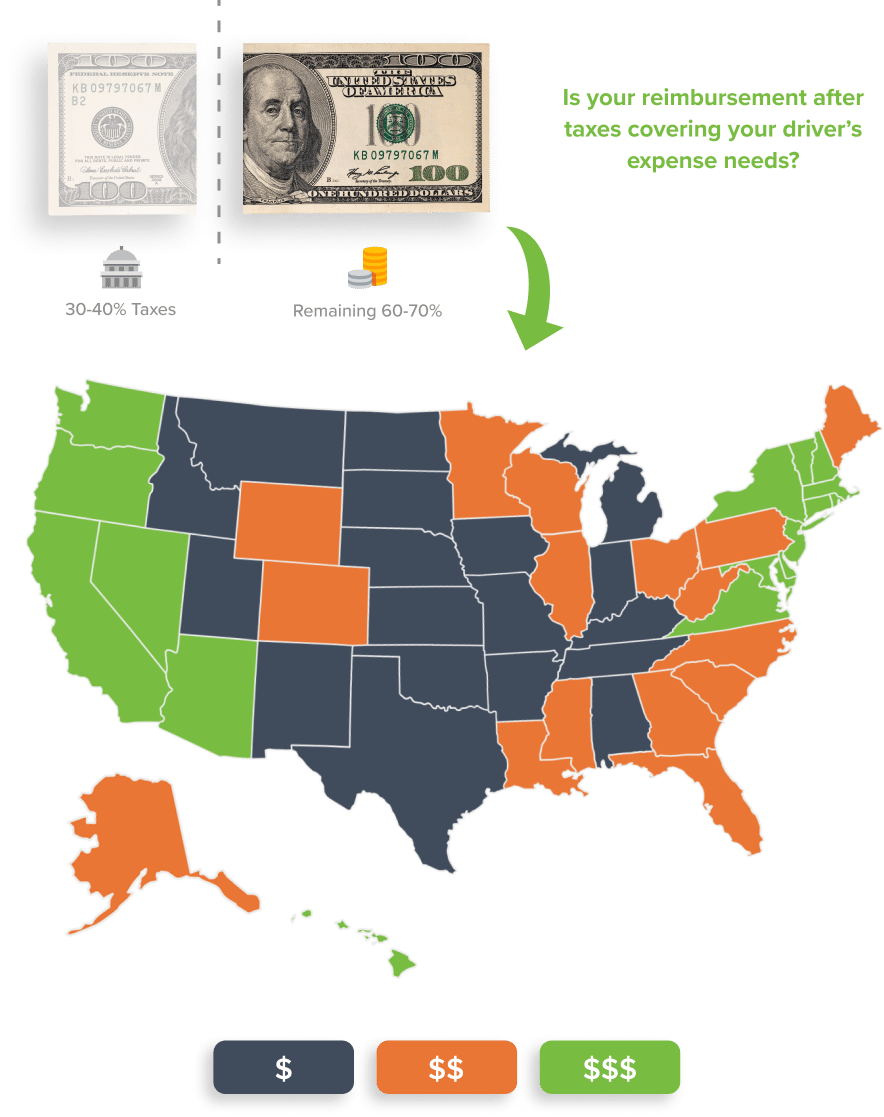
Sample report preview.
| Benchmark item | Sample finding | Risk signal | Recommended action |
|---|---|---|---|
| Current allowance | $650/month flat stipend | Review | Model after-tax value and mileage variance |
| After-tax employee value | Estimated $390-$455 | Tax friction | Compare to actual driving cost |
| Regional cost variance | High variance across CA, TX, and FL | Uneven pay | Model costs by ZIP code |
| Mileage variance | Drivers range from 400 to 1,400 miles/month | Misalignment | Consider a variable component |
| Program recommendation | FAVR suitability: high | Opportunity | Schedule reimbursement review |
How mBurse benchmarks your allowance.
mBurse benchmarks your current allowance against the factors that actually determine whether a vehicle program is fair, competitive, and cost-effective: mileage volume, employee location, fixed vehicle ownership costs, variable operating costs, tax treatment, and reimbursement model.
Profile your program
Share your allowance amount, program type, number of mobile employees, and typical mileage.
Compare against cost drivers
Review mileage, taxes, vehicle operating costs, fixed ownership costs, and regional differences.
Right-size the policy
Receive a practical roadmap to reduce waste, improve fairness, and explore tax-free reimbursement options.
Identify reimbursement risk
Find where the policy may overpay low-mileage drivers or underpay high-mileage employees.
Recommend the next step
Determine whether to adjust the allowance, add mileage reimbursement, or evaluate FAVR.
Align HR, Finance, Sales Ops, and Procurement around one data-backed policy.
Vehicle reimbursement touches employee satisfaction, payroll taxes, compliance, spend control, and field productivity. The benchmark report gives every stakeholder the same starting point.
Car allowance questions, answered.
-
Is a car allowance taxable?
A flat monthly allowance is generally treated as taxable compensation unless it is paid through an accountable plan with proper business mileage documentation. Taxability can reduce the employee's take-home value and make the benefit feel smaller than the amount shown on payroll. -
What should a company car allowance cover?
It should account for fixed costs such as insurance, taxes, registration, licensing, and depreciation, plus variable costs such as fuel, oil, tires, maintenance, and business mileage. -
Is mileage reimbursement better than a car allowance?
It depends. Mileage reimbursement can better reflect actual use, while a flat allowance is easier to administer but may create overpayment, underpayment, and tax issues. High-variance workforces often benefit from a fixed and variable reimbursement model. -
What is FAVR reimbursement?
FAVR stands for fixed and variable rate reimbursement. It combines a fixed payment for ownership costs with a variable cents-per-mile payment for operating costs, helping reimbursement align with location, mileage, and vehicle expense differences. -
What is included in the mBurse benchmark report?
The report includes allowance competitiveness, after-tax value, regional cost considerations, overpayment and underpayment risks, IRS mileage-rate context, and recommended next steps for your policy. -
What is a fair car allowance in 2026
A fair 2026 car allowance should reflect employee mileage, local vehicle costs, tax treatment, required vehicle type, territory size, and whether the allowance is taxable or paid through an accountable reimbursement plan. The 2026 IRS business mileage rate is 72.5 cents per mile, but a fair allowance should be benchmarked against the actual employee population and policy goals.
-
Is the IRS mileage rate the same as a car allowance benchmark?
No. The IRS mileage rate is a national cents-per-mile rate used for tax and reimbursement purposes. A car allowance benchmark should also evaluate fixed vehicle costs, variable operating costs, employee geography, mileage variance, tax treatment, and whether a flat stipend creates overpayment or underpayment.
-
Why benchmark a car allowance?
Benchmarking helps employers identify whether their policy is competitive, fair, tax-efficient, and aligned with real driving costs. It can reveal overpayment risk, underpayment risk, regional cost gaps, and whether a tax-free reimbursement model may better support mobile employees.
-
How is this different from a generic car allowance average?
A generic average can show what other companies pay, but it does not show whether your allowance is right for your employees, mileage patterns, tax treatment, required vehicle type, or regional costs. The mBurse benchmark compares your policy against the factors that determine whether your program is fair, competitive, and cost-effective. -
When should a company replace a car allowance with FAVR?
A company should evaluate FAVR when a flat allowance creates tax waste, regional pay differences, high mileage variance, or underpayment risk. FAVR may be a better fit when employees drive regularly for work and reimbursement needs to reflect fixed ownership costs and variable driving costs.
Stop guessing what your car allowance should be.
A flat monthly allowance may be simple, but it can also create tax waste, overpay low-mileage drivers, and underpay employees who drive a lot or live in high-cost regions.
Get a free 2026 benchmark report to see whether your current program is competitive, fair, and cost-effective